
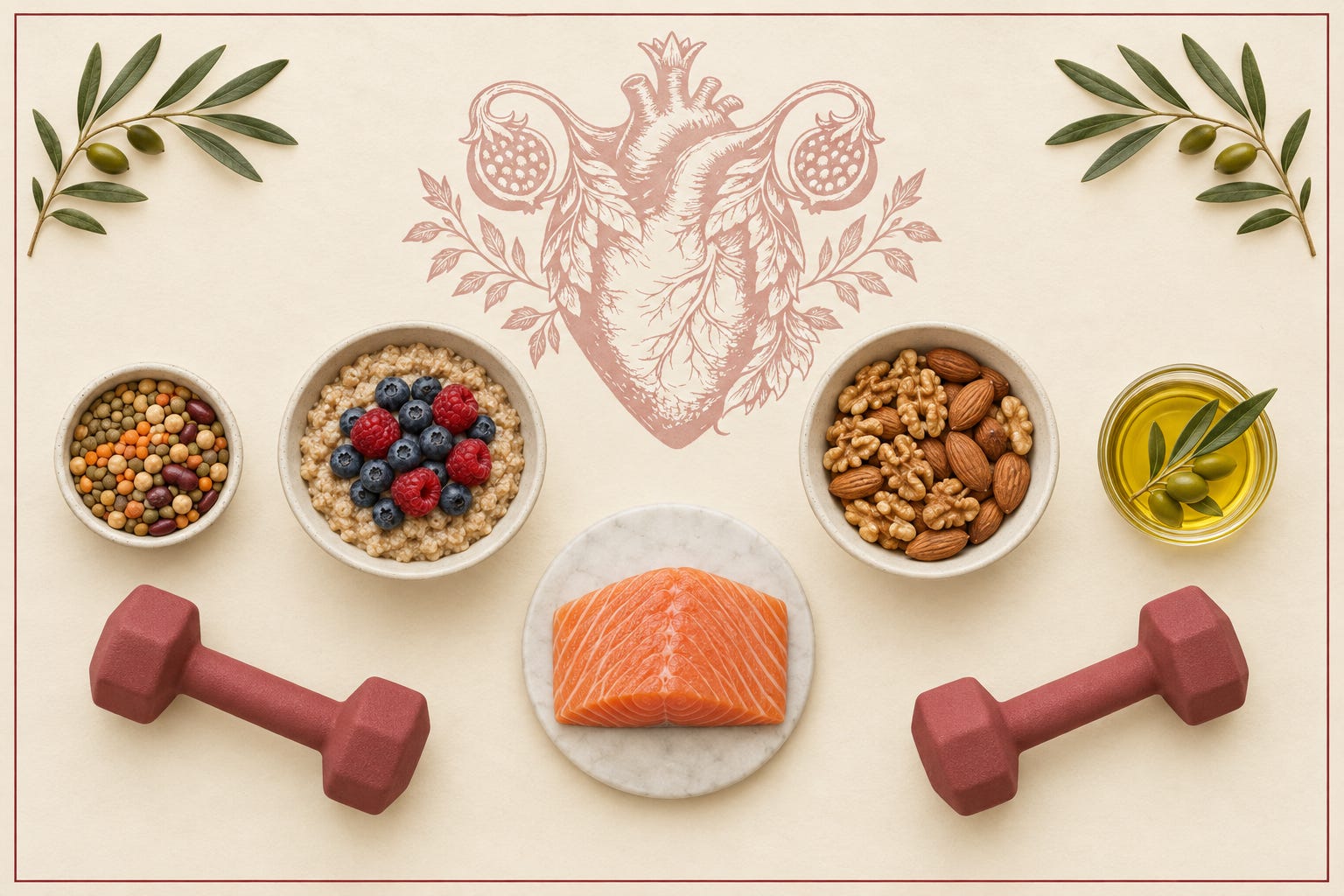
The Short Version
Menopause changes which levers work best. The lipid shift is real — LDL and apoB tend to rise, HDL becomes less protective, triglycerides climb. Diet and exercise still work; some levers just work harder in this window than others.
Fiber target: 25–30 grams per day, with soluble fiber prioritized. Oats, beans, lentils, psyllium, chia, flax, barley, apples, berries. The evidence for LDL lowering with soluble fiber is stronger in postmenopausal women than in premenopausal women.
Protein target: 1.0–1.3 grams per kilogram of body weight per day. Distributed roughly evenly across meals — about 25–30 g per meal — not stacked at dinner. This is the single most important dietary change most postmenopausal women aren’t making.
Fat quality matters more than fat quantity. Prioritize olive oil, nuts, seeds, and fatty fish. Minimize ultra-processed foods and industrial trans fats.
Two servings of fatty fish per week — salmon, sardines, mackerel, anchovies, trout. Fish oil supplements have a role, but a narrower one than most people think.
Reduce ultra-processed foods and refined starch. Insulin resistance rises after menopause. Refined carbohydrates land harder than they used to.
Alcohol needs an honest reset at midlife. Breast cancer risk rises with any amount. Hot flashes and sleep get worse. This is not prohibition — it is a real cost-benefit conversation.
Resistance training 2–3 sessions per week is not optional. Compound movements, real load. It protects bone, muscle, insulin sensitivity, and — in meta-analysis of trials in postmenopausal women — lipids.
Aerobic activity: 150+ minutes moderate or 75+ minutes vigorous per week. Adds triglyceride and HDL improvements resistance training doesn’t deliver as reliably.
Sleep and stress are multipliers. Poor sleep raises cortisol, drives insulin resistance, and undoes some of the work of everything else. Menopause makes sleep worse. Protecting it is part of the intervention, not separate from it.
A Quick Recap
In Part 1 we mapped the shift: menopause rearranges the cholesterol fleet. LDL and apoB tend to rise. HDL — the “good” cholesterol — often stays the same or rises slightly, but becomes less functional. Triglycerides climb. Some women see a Lp(a) bump. Visceral fat redistributes to the abdomen. Insulin sensitivity declines. Vascular inflammation rises.
The result is a cardiovascular risk trajectory that accelerates in the years around and after menopause, not because women suddenly develop new disease, but because the underlying biology of the fleet has changed. The good news: most of that biology is responsive to lifestyle. The lifestyle changes just have to match the new physiology, not the old one.
A quick word on Lp(a). Lp(a) is different from the rest of the fleet. It is largely inherited and usually stays fairly stable across life, though some evidence suggests it may rise modestly around menopause. Lp(a) does not respond meaningfully to diet or exercise. If you have never had it measured, the menopausal transition is a sensible time to check it once and put the number in context with the rest of your risk picture.
A note from my own practice. I have been screening patients for Lp(a) for at least fifteen years — well before it became the topic of the week. In the early years I did not test everyone. I tested patients with early cardiovascular disease themselves, a family history of premature heart disease, or an unknown family history (including adoptees). And the assays available then reported in mg/dL, which could not distinguish larger from smaller Lp(a) particles the way today’s nmol/L assays can.
What I actually use the number for in clinic: as a tiebreaker on aggressiveness. Every patient of mine gets the anti-inflammatory diet talk, the LDL and apoB conversation, and the exercise conversation — but the room has a clock on it. Patients with a high Lp(a) and elevated inflammatory markers (hs-CRP, IL-6) are the ones I know I have to sit with longer, follow more closely, and push harder on aggressive LDL reduction and anti-inflammatory eating. There is emerging evidence that lower inflammatory markers may attenuate the cardiovascular risk associated with a high Lp(a), which is why I read the two numbers together rather than in isolation. It tells me which patients really need the hand-holding to put the fire out.
On the diet side, the peer-reviewed evidence is that Lp(a) does not respond meaningfully to diet or exercise — and that remains the honest overall answer. But there are some patterns I have watched in my own patients over two decades that I want to share as clinical observation rather than published data. I have seen Lp(a) drop with the regular addition of seafood to the diet — including one striking comparison in genetically identical twin patients whose only meaningful dietary difference was seafood intake, with Lp(a) of 186 vs. 224 nmol/L in the seafood-eating twin vs. the non-seafood twin. Conversely, I have seen Lp(a) rise in some patients who moved to a strict plant-based pattern with severe restriction of animal foods, even as LDL fell substantially — almost as if a compensatory vascular repair mechanism ramps up “just in case.” The saturated-fat feeding literature is consistent with this direction (LDL falls, Lp(a) rises when saturated fat is sharply reduced). None of this is a reason to add red meat or skip a plant-forward pattern for cardiovascular reasons — the total-risk math still favors the pattern that lowers apoB. But it is a reason to check Lp(a) when a patient makes a large dietary shift, and a reason to keep pushing for more research on Lp(a) modifiability.
This part is about what to actually do — the specific dietary and exercise habits with the strongest evidence in this population.
Fiber Comes First
Target: 25–30 grams total dietary fiber per day. Prioritize soluble fiber.
Soluble fiber is the gel-forming kind — in oats, barley, beans, lentils, psyllium, chia, flaxseed, apples, and berries. It works by grabbing bile in the gut and pulling it out in stool, forcing the liver to make more bile and, to do that, open more LDL depot stations to pull cholesterol out of the blood.
A 2023 systematic review and dose-response meta-analysis of randomized trials found that soluble fiber supplementation significantly reduced serum triglycerides, total cholesterol, LDL cholesterol, and apolipoprotein B (Ghavami et al., Adv Nutr 2023). A prospective cohort of healthy women found that consuming at least 22 g/day of total fiber was independently associated with lower total and LDL cholesterol (Mumford et al., Am J Epidemiol 2010). And a pilot trial that separated pre- and postmenopausal responses to psyllium fiber found the total cholesterol reduction was significant in postmenopausal women (about 5.2%) but not in premenopausal women (about 1.3%) at the same dose (Ganji & Kuo, Nutrition Journal 2008). The postmenopausal fleet appears to respond more readily to fiber than the premenopausal one does.
Practical: half a cup of cooked oats or barley plus a cup of beans or lentils plus a couple of servings of fruit and vegetables gets most women well into range. If food alone isn’t getting you there, a rounded teaspoon of psyllium once or twice a day is one of the best-studied supplements in medicine.
Protein: The Most Underrated Lever
Target: 1.0–1.2 grams per kilogram of body weight per day. Distributed across meals — roughly 25–30 g per meal.
Estrogen loss accelerates the age-related loss of muscle mass and strength — sarcopenia. That matters for cardiovascular disease in two ways: less muscle means worse glucose disposal (and rising insulin resistance), and less muscle means worse functional capacity later, which drives cardiovascular events indirectly.
Multiple expert groups now recommend 1.0–1.3 g/kg/day for adults over 50, with higher intakes for adults who are actively resistance training or recovering from illness (Nowson & O’Connell, Nutrients 2015). For a 65 kg (143 lb) woman that is roughly 65–85 g of protein per day.
Distribution matters as much as total. Older muscle is less responsive to protein than younger muscle — a phenomenon called “anabolic resistance.” Roughly 25–30 g of high-quality protein per meal appears to be the threshold that reliably stimulates muscle protein synthesis in older adults (Nowson & O’Connell, Nutrients 2015). Loading protein at dinner and skipping it at breakfast — a common pattern — does not use daily protein as efficiently as spreading it out (Mamerow et al., J Nutr 2014).
Practical: aim for a protein source at every meal. Greek yogurt or eggs at breakfast, beans or fish or tofu at lunch, a palm-sized portion of fish, poultry, or lean meat at dinner. A cup of cottage cheese, a serving of tempeh, or a scoop of whey protein all clear the 25–30 g threshold. This is one of the highest-yield changes most women can make, and it costs nothing.
Fat Quality Over Fat Quantity
Prioritize olive oil, nuts, seeds, and fatty fish. Minimize ultra-processed foods and industrial trans fats.
The old fear of dietary fat has largely been replaced by a more useful question: what kind of fat, and what does it replace? Substituting polyunsaturated fat (from nuts, seeds, olive oil, and fatty fish) for saturated fat lowers LDL cholesterol and, in stable-isotope studies of adults with dyslipidemia and insulin resistance, directly reduces the production rate of apoB-100 — the tag on every atherogenic particle (Drouin-Chartier et al., Am J Clin Nutr 2018). Feeding trials that lower saturated fat in a DASH-type diet reliably reduce LDL cholesterol, though effects on some lipid subfractions like Lp(a) can move in the opposite direction — one reason blanket “low fat” advice is less useful than pattern-based guidance (Law et al., J Lipid Res 2023).
The dietary pattern with the most cardiovascular outcome data is the Mediterranean diet — olive oil as the primary fat, generous vegetables and legumes, whole grains, fish two or more times per week, moderate dairy, minimal red meat, minimal processed food. The European Menopause and Andropause Society position statement concluded that long-term Mediterranean adherence in menopausal women can improve cardiovascular risk, bone mineral density, and reduce risk of cognitive decline and breast cancer (Cano et al., EMAS Position Statement, Maturitas 2020).
Practical: olive oil as the primary cooking fat. A handful of walnuts or almonds most days. Fatty fish twice a week. Butter and cheese as flavor, not staples. Ultra-processed convenience food kept to the exception rather than the rule.
Fatty Fish, Twice a Week
Target: 2 servings of fatty fish per week (salmon, sardines, mackerel, anchovies, herring, or trout).
The American Heart Association Scientific Advisory on seafood omega-3s concluded that 1–2 seafood meals per week should be included to reduce the risk of coronary heart disease, ischemic stroke, congestive heart failure, and sudden cardiac death (Rimm et al., Circulation 2018). A 2023 systematic review and dose-response meta-analysis of RCTs specifically in postmenopausal women found that omega-3 supplementation significantly reduced triglycerides and modestly raised HDL, though it also modestly raised LDL — a reminder that omega-3s are not primarily an LDL-lowering strategy (Wang et al., Clin Ther 2023). The Spanish Menopause Society recommends long-chain omega-3 intake as a component of cardiovascular risk reduction in this population (Sánchez-Borrego et al., Maturitas 2017).
Over-the-counter fish oil is a different conversation. Its primary measurable effect is on triglycerides, not LDL. Detailed treatment lives in Part 3 and future deep dives.
Practical: food first. A can of sardines on toast, a serving of grilled salmon, a piece of mackerel — twice a week is enough to matter.
Fewer Ultra-Processed Foods, Fewer Refined Starches
Target: keep ultra-processed foods to the minority of what you eat, not the majority.
Insulin sensitivity declines after menopause — as estrogen falls, cells become less responsive to insulin, and glucose control becomes harder (Harvard Health, insulin resistance in women over 50). That physiological shift changes what a “bad” trade in eating looks like. Replacing saturated fat with refined starch and sugar — the standard low-fat move of the 1990s — is a worse trade at 55 than it was at 35.
In the Australian Longitudinal Study on Women’s Health, middle-aged women in the highest ultra-processed food intake group had significantly higher rates of incident hypertension than those in the lowest (Pant et al., Eur J Nutr 2024). A separate 25-year Australian prospective cohort of nearly 40,000 adults found the highest UPF-intake group had 19% higher cardiovascular mortality than the lowest (Gauci et al., Eur J Prev Cardiol 2025). And a multinational European cohort of 266,000 adults found higher UPF intake was associated with increased risk of multimorbidity of cancer and cardiometabolic disease (Cordova et al., Lancet Reg Health Eur 2023).
“Ultra-processed” is a specific category, not just “processed” — it means industrially formulated products made largely from substances derived from foods rather than whole foods, typically containing additives, emulsifiers, and preservatives, and designed for convenience and long shelf life. Sodas, packaged snacks, most breakfast cereals, sweetened yogurts, deli meats, most packaged baked goods. It is not the same as freezing vegetables or making a simple soup.
Practical: more meals cooked from recognizable ingredients. Whole grains over ground flour. Beans and legumes several times a week. Sugar-sweetened beverages as an occasional pleasure, not a beverage habit.
Alcohol: An Honest Reset
No safe level for breast cancer risk, and menopause symptoms worsen with alcohol. This is a cost-benefit conversation, not prohibition.
A 2024 systematic review and meta-analysis of prospective cohorts confirmed that alcohol consumption increases female breast cancer risk, including at consumption below one standard drink per day, and applies to both pre- and postmenopausal breast cancer (Sohi et al., Alcohol Clin Exp Res 2024). The risk is dose-dependent and is stronger for hormone-receptor-positive tumors (Suzuki et al., JNCI 2005). No large study has found a lower threshold below which alcohol is neutral for breast cancer risk.
On top of that, alcohol worsens hot flashes and disrupts sleep — the two symptoms that already interfere most with the health of women in this window. It widens blood vessels (worsening flushes) and fragments the second half of the sleep cycle even when it initially feels sedating (Mayo Clinic, Menopause and Alcohol).
Practical: this does not have to be prohibition. But the honest framing is that alcohol has real costs at midlife that it did not have at 30, and any use should be a deliberate choice with those costs on the table. If you drink daily, aim to reduce frequency first — several alcohol-free days per week — before worrying about volume on drinking days.
Resistance Training: Not Optional
Target: 2–3 sessions per week, real load, compound movements. Progressive over months.
This is the biggest single MH-specific recommendation in this article. Estrogen loss accelerates loss of muscle mass and bone. Resistance training is the intervention with the strongest evidence for slowing both, and it also delivers cardiometabolic benefits that pure aerobic work does not.
A 2023 systematic review and meta-analysis of resistance training trials in postmenopausal women concluded that resistance training reduces total cholesterol, LDL cholesterol, and triglycerides, with minimal effects on HDL except in participants with obesity (He et al., Eur J Obstet Gynecol Reprod Biol 2023). A separate meta-analysis of resistance training in postmenopausal women found significant bone mineral density gains at the lumbar spine, femoral neck, and total hip — the sites that matter most for fracture risk (Zhao et al., J Orthop Surg Res 2025). A separate systematic review found that resistance training also improved functional capacity and reduced hot flash frequency in postmenopausal women, though the certainty of evidence was low (Sá et al., Menopause 2023). Effective programs across pooled RT trials in menopausal women typically run 3 sessions per week for 20–60 minutes, sustained for at least 6–12 weeks (Tan et al., BMC Women’s Health 2023).
Practical: compound movements that load multiple joints and large muscle groups — squats, deadlifts or hip hinges, presses, rows, and carries. Real weight, not pink dumbbells. If you’re new to it, a few sessions with a qualified trainer is worth the cost. If you already lift, keep progressing the load slowly. The point is not to become a competitive lifter — it’s to give your bones and muscles a mechanical signal loud enough to overcome the hormonal signal telling them to shrink.
Aerobic Training: The Complementary Lever
Target: 150+ minutes per week of moderate-intensity aerobic activity, OR 75+ minutes of vigorous-intensity, OR a mix.
Aerobic exercise pulls a different lever than resistance training. It moves triglycerides and HDL more than LDL and improves endothelial function, blood pressure, insulin sensitivity, and cardiorespiratory fitness — one of the strongest predictors of all-cause mortality we have.
A 2024 systematic review of aerobic exercise trials specifically in postmenopausal women found improvements in LDL (–10.5 mg/dL), HDL (+3.3 mg/dL), systolic blood pressure (–4.4 mmHg), and cardiorespiratory fitness (Huynh et al., Women’s Health (Lond) 2024). A 2025 meta-analysis in peri- and postmenopausal women found physical exercise raised HDL in perimenopausal women, and in obese postmenopausal women, roughly 16 weeks of aerobic training raised HDL and lowered total and LDL cholesterol (Bernal et al., Braz J Med Biol Res 2025). The U.S. Physical Activity Guidelines for Americans recommend 150–300 minutes of moderate or 75–150 minutes of vigorous activity per week, plus at least two days of muscle-strengthening activity (U.S. HHS, Physical Activity Guidelines for Americans 2nd Ed., 2018).
Practical: a mix beats a single mode. Most of the aerobic minutes can be conversational-pace walking, biking, swimming, or hiking — genuinely comfortable, sustainable, not exhausting. A smaller share should be harder — enough that you can only speak in short phrases. If time is the constraint, brief vigorous work (10–20 minutes, 2–3 times per week) can substitute for a good portion of the moderate volume.
Time-Restricted Eating: Reasonable for Some, Not Universal
If you do it, keep the eating window generous (10–12 hours) and protect protein distribution.
Time-restricted eating (TRE) — narrowing the daily eating window — has modest evidence for improving body weight and composition, but effects on lipids and glucose are inconsistent and largely explained by whatever caloric reduction happens to accompany the shorter window. A 2023 meta-analysis of RCTs found that TRE combined with calorie restriction reduced body weight, fat mass, and waist circumference but produced no significant additional benefit to blood pressure, glucose, or lipid profiles beyond calorie restriction alone (Sun et al., Eur J Clin Nutr 2023). A 2025 meta-analysis in overweight and obese women found similar patterns — weight and fasting insulin down, but no significant effect on lipids, BMI, visceral fat, or blood pressure (Chen et al., Front Nutr 2025). A 2025 RCT in postmenopausal women found that TRE combined with Tai Chi outperformed TRE alone for total and LDL cholesterol reductions and endothelial function — suggesting that any TRE benefit in this population is heavily amplified by adding exercise (Wang et al., J Int Soc Sports Nutr 2025).
The honest picture: this is a reasonable tool for some women. It is not magic. And it is not neutral — very short eating windows (6–8 hours) can worsen sleep, mood, and hot flashes in some perimenopausal women, and can make it harder to hit the daily protein target and per-meal protein distribution that matter for muscle preservation.
Practical: if you want to try it, start at a 12-hour window (e.g., 7 AM to 7 PM) — mostly a matter of ending the eating day earlier rather than skipping breakfast. Notice how your sleep and mood respond over two weeks. Do not compromise the protein target to fit a narrower window.
Sleep and Stress: The Multipliers
Protecting sleep and managing chronic stress is not a soft add-on. It is part of the cardiovascular intervention.
Sleep quality worsens across the menopausal transition. Estrogen loss and vasomotor symptoms fragment sleep, and disturbed sleep during this period is associated with increased cardiometabolic risk and adverse cardiovascular outcomes (Sparks & Wang, Healthcare (Basel) 2025). Experimental work in a human model of menopause found that sleep fragmentation increased bedtime cortisol by 27% and blunted the cortisol awakening response by 57%, independent of estradiol suppression — a mechanistic link between fragmented sleep and downstream cardiometabolic risk (Cohn et al., J Clin Endocrinol Metab 2023). Cross-sectional data in postmenopausal women also show that those with poorer sleep quality carry higher 10-year cardiovascular risk than those with good sleep (Chair et al., BMC Womens Health 2017).
Which means: if diet and exercise are the levers, sleep is the fulcrum they pivot on. Chronically bad sleep undoes some of what everything else does.
Practical: keep the bedroom cool and dark. Anchor a consistent wake time even on weekends. Get morning daylight into your eyes within an hour of waking. Limit alcohol and heavy meals in the three hours before sleep. Aggressive treatment of hot flashes and night sweats when they are the main sleep disruptor — this is where hormone therapy and other prescription options come into the conversation, and is worth an honest discussion with your clinician. Chronic insomnia in this window deserves evaluation, not just tolerance.
Putting the Map Together
For most postmenopausal women, the highest-yield lifestyle stack looks something like this:
Fiber every meal, protein every meal. 25–30 g fiber daily, ~25–30 g protein per meal, most from whole foods.
Fat quality shifted toward olive oil, nuts, seeds, and fatty fish — the Mediterranean pattern is the best-tested framework.
Ultra-processed foods and refined starch pushed to the margins — not eliminated, just no longer the default.
Alcohol honestly reassessed — reduce frequency first, volume second, and know what you are trading for.
Resistance training 2–3x per week with real load. Compound movements. Progressive.
150+ minutes per week of moderate aerobic activity, mixed with some vigorous work.
Sleep protected as if it were a medication. Because functionally, it is one.
None of this is exotic. All of it is boring. And all of it has better evidence — often specifically in postmenopausal cohorts — than any supplement, cleanse, or protocol currently trending.
Lifestyle is foundational, but it is not always sufficient. ApoB, LDL, non-HDL cholesterol, Lp(a), diabetes, blood pressure, family history, coronary calcium, and known plaque all help determine whether medication should be added to the plan. Medication is not a failure of lifestyle. It is another evidence-based way to reduce lifetime cardiovascular risk, and for many women it is the difference between doing everything right and still watching risk accumulate versus actually bending the curve.
Part 3 covers the prescription medications and supplements postmenopausal women ask about most. That article is a general overview of what actually moves the fleet with a prescription pad, and where the supplement aisle is honest, modest, or misleading. Deep dives into individual medications, hormone therapy, and specific supplements will follow over the coming months.
Key Sources
Fiber
Ghavami A, Ziaei R, Talebi S, et al. Soluble fiber supplementation and serum lipid profile: a systematic review and dose-response meta-analysis of randomized controlled trials. Adv Nutr. 2023. https://pmc.ncbi.nlm.nih.gov/articles/PMC10201678/
Mumford SL, Schisterman EF, Siega-Riz AM, et al. Effect of dietary fiber intake on lipoprotein cholesterol levels independent of estradiol in healthy premenopausal women. Am J Epidemiol. 2010. https://pmc.ncbi.nlm.nih.gov/articles/PMC3290909/
Ganji V, Kuo J. Serum lipid responses to psyllium fiber: differences between pre- and post-menopausal, hypercholesterolemic women. Nutrition Journal. 2008. https://pmc.ncbi.nlm.nih.gov/articles/PMC2533348/
Protein
Nowson C, O’Connell S. Protein requirements and recommendations for older people: a review. Nutrients. 2015. https://pmc.ncbi.nlm.nih.gov/articles/PMC4555150/
Mamerow MM, Mettler JA, English KL, et al. Dietary protein distribution positively influences 24-h muscle protein synthesis in healthy adults. J Nutr. 2014;144(6):876-880. https://www.sciencedirect.com/science/article/pii/S0022316622009087
Fat quality and Mediterranean diet
Drouin-Chartier JP, Tremblay AJ, Lépine MC, et al. Substitution of dietary ω-6 polyunsaturated fatty acids for saturated fatty acids decreases LDL apolipoprotein B-100 production rate in men with dyslipidemia associated with insulin resistance. Am J Clin Nutr. 2018. https://pubmed.ncbi.nlm.nih.gov/29381796/
Law HG, Khan MA, Zhang W, et al. Reducing saturated fat intake lowers LDL-C but increases Lp(a) levels in African Americans: the GET-READI feeding trial. J Lipid Res. 2023. https://www.jlr.org/article/S0022-2275(23)00093-7/fulltext
Cano A, et al. The Mediterranean diet and menopausal health: an EMAS position statement. Maturitas. 2020. https://emas-online.org/wp-content/uploads/2020/07/The-Mediterranean-diet-and-menopausal-health.pdf
Fatty fish and omega-3
Rimm EB, Appel LJ, Chiuve SE, et al. Seafood Long-Chain n-3 Polyunsaturated Fatty Acids and Cardiovascular Disease: A Science Advisory From the AHA. Circulation. 2018. https://www.ahajournals.org/doi/pdf/10.1161/CIR.0000000000000574
Wang J, et al. Does Omega-3 Fatty Acid Supplementation Have Favorable Effects on the Lipid Profile in Postmenopausal Women? A Systematic Review and Dose-response Meta-analysis of Randomized Controlled Trials. Clin Ther. 2023. https://pubmed.ncbi.nlm.nih.gov/36641259/
Sánchez-Borrego R, et al. Recommendations of the Spanish Menopause Society on the consumption of omega-3 polyunsaturated fatty acids by postmenopausal women. Maturitas. 2017. https://rodin.uca.es/bitstream/handle/10498/38396/Maturitas2017postprintSI.pdf?sequence=1
Ultra-processed foods
Pant A, et al. Ultra-processed foods and incident cardiovascular disease and hypertension in middle-aged women. Eur J Nutr. 2024. https://pubmed.ncbi.nlm.nih.gov/38147150/
Gauci S, Lotfaliany M, Machado P, et al. Exposure to ultra-processed food and risk of cardiovascular mortality: a prospective cohort study. Eur J Prev Cardiol. 2025. https://academic.oup.com/eurjpc/article/32/16/1564/8173892
Cordova R, Viallon V, Fontvieille E, et al. Consumption of ultra-processed foods and risk of multimorbidity of cancer and cardiometabolic diseases: a multinational cohort study. Lancet Reg Health Eur. 2023. https://www.thelancet.com/journals/lanepe/article/PIIS2666-7762(23)00190-4/fulltext
Alcohol
Sohi I, Rehm J, Saab M, et al. Alcoholic beverage consumption and female breast cancer risk: A systematic review and meta-analysis of prospective cohort studies. Alcohol Clin Exp Res. 2024. https://onlinelibrary.wiley.com/doi/10.1111/acer.15493
Suzuki R, Ye W, Rylander-Rudqvist T, et al. Alcohol and postmenopausal breast cancer risk defined by estrogen and progesterone receptor status: a prospective cohort study. J Natl Cancer Inst. 2005. https://academic.oup.com/jnci/article/97/21/1601/2521457
Time-restricted eating
Sun JC, Tan ZT, He CJ, et al. Time-restricted eating with calorie restriction on weight loss and cardiometabolic risk: a systematic review and meta-analysis. Eur J Clin Nutr. 2023. https://www.nature.com/articles/s41430-023-01311-w
Chen S, Zhang X, Kortas J, Liu H. Effects of time-restricted eating on body composition and metabolic parameters in overweight and obese women: a systematic review and meta-analysis. Front Nutr. 2025. https://www.frontiersin.org/journals/nutrition/articles/10.3389/fnut.2025.1664412/full
Wang XY, Chen J, Li H. The effects of time-restricted eating combined with Tai Chi on glycolipid metabolism and endothelial function in postmenopausal women. J Int Soc Sports Nutr. 2025. https://pmc.ncbi.nlm.nih.gov/articles/PMC12632245/
Resistance training
He Q, et al. Effect of resistance training on lipid profile in postmenopausal women: A systematic review and meta-analysis of randomized controlled trials. Eur J Obstet Gynecol Reprod Biol. 2023. https://www.sciencedirect.com/science/article/abs/pii/S0301211523002658
Zhao F, Su W, Sun Y, et al. Optimal resistance training parameters for improving bone mineral density in postmenopausal women: a systematic review and meta-analysis. J Orthop Surg Res. 2025. https://pmc.ncbi.nlm.nih.gov/articles/PMC12107943/
Sá KMM, et al. Resistance training for postmenopausal women: systematic review and meta-analysis. Menopause. 2023. https://pubmed.ncbi.nlm.nih.gov/36283059/
Tan TW, Tan HL, Hsu MF, Huang HL, Chung YC. Effect of non-pharmacological interventions on the prevention of sarcopenia in menopausal women: a systematic review and meta-analysis of randomized controlled trials. BMC Women’s Health. 2023. https://pmc.ncbi.nlm.nih.gov/articles/PMC10647115/
Aerobic training
Huynh E, Wiley E, Noguchi KS, et al. The effects of aerobic exercise on cardiometabolic health in postmenopausal females: A systematic review and meta-analysis of randomized controlled trials. Womens Health (Lond). 2024. https://pmc.ncbi.nlm.nih.gov/articles/PMC11503877/
Bernal JVM, Sánchez-Delgado JC, Jácome-Hortúa AM, et al. Effects of physical exercise on the lipid profile of perimenopausal and postmenopausal women: a systematic review and meta-analysis. Braz J Med Biol Res. 2025. https://pmc.ncbi.nlm.nih.gov/articles/PMC11884766/
U.S. Department of Health and Human Services. Physical Activity Guidelines for Americans, 2nd Edition. 2018. https://odphp.health.gov/sites/default/files/2019-09/Physical_Activity_Guidelines_2nd_edition.pdf
Sleep and cortisol
Sparks JR, Wang X. Menopause-Related Changes in Sleep and the Associations with Cardiometabolic Health: A Narrative Review. Healthcare (Basel). 2025. https://pmc.ncbi.nlm.nih.gov/articles/PMC12428155/
Cohn AY, Grant LK, Nathan MD, et al. Effects of Sleep Fragmentation and Estradiol Decline on Cortisol in a Human Experimental Model of Menopause. J Clin Endocrinol Metab. 2023. https://pmc.ncbi.nlm.nih.gov/articles/PMC10584010/
Chair SY, Wang Q, Cheng HY, et al. Relationship between sleep quality and cardiovascular disease risk in Chinese post-menopausal women. BMC Womens Health. 2017. https://pubmed.ncbi.nlm.nih.gov/28893224/