

The Menopause Heart · By Sameer Azhak, MD, FACC
At a Glance
Sleep apnea becomes more common after menopause. In one long-running study, postmenopausal women had about two and a half times the odds of sleep-disordered breathing as premenopausal women, even after accounting for age and body size.¹
You may notice insomnia, frequent waking, morning headaches, fatigue, or mood changes rather than the loud snoring you associate with sleep apnea.²,³
Sleep apnea can contribute to high blood pressure, including pressure that stays elevated at night or is difficult to control.⁴,⁵
Screening questionnaires and home sleep tests have limits. A low screening score or a negative home test should not automatically end the conversation when symptoms persist.⁶,⁷,⁸
Treatment can improve symptoms and modestly lower blood pressure on average. It does not guarantee that you can stop medication.⁹,¹⁰,¹¹
Hormone therapy and sleep-apnea treatment are separate decisions. Hormone therapy is not a treatment for sleep apnea.¹²,¹³
You go to bed tired. You wake at 2 a.m., then again at 4.
Sometimes you are hot. Sometimes you are just awake.
By morning, you feel as though you never really slept. By mid-afternoon, the fog settles in. Your blood pressure, once unremarkable, now reads higher than you expect—often first thing in the morning.
It is easy to file all of this under one word: menopause.
And menopause may be part of the story. Hot flashes and night sweats interrupt sleep. Hormonal changes can affect how you sleep and how you feel the next day.
But another possibility deserves a place in the conversation: obstructive sleep apnea.
It is common. It is often missed in women. And when it is present, we can treat it.²,³
This is not a reason to assume every bad night is a breathing problem. It is a reason to ask one more question when sleep, energy, and blood pressure all change at once.
What happens when breathing stops at night
In my companion article in The Integrative Cardiologist, “Blood Pressure and Sleep Apnea: What Happens While You Sleep Matters,” I explain the blood-pressure connection in detail.
Here is the short version.
During sleep, the muscles that help hold your throat open relax. In obstructive sleep apnea, the airway narrows or closes again and again through the night. Oxygen may fall, and your brain briefly rouses you to reopen the airway—usually too briefly for you to remember.⁴
Each of those events can trigger a burst of your body’s stress response. Heart rate rises. Blood vessels tighten. Blood pressure surges. Repeated night after night, that pattern can carry over into the day.⁴,⁵
One clue is what blood pressure does overnight.
Normally, it falls during sleep—a healthy nighttime “dip.” Sleep apnea can blunt or remove that dip. An office visit can miss the pattern because it measures your pressure while you are awake.⁵
Morning home readings can raise the question, but they cannot show exactly what happened overnight. A 24-hour ambulatory monitor can.
What menopause changes
Sleep apnea becomes more common after menopause. Changes in breathing drive, airway-muscle function, aging, and fat distribution may all contribute.¹,¹³,¹⁴,¹⁵
Breathing drive and the airway
Progesterone stimulates breathing, and sex hormones influence the muscles that help keep the upper airway open. Changes in those signals may make breathing less stable during sleep in some women.¹²,¹³
That is part of the explanation—not proof that every new sleep problem is hormonal.
Where fat is stored
Changes in fat distribution may matter even when the scale barely moves.
In a U.S. survey analysis, postmenopausal women had more visceral fat—the fat around the abdominal organs—and more reported sleep-apnea symptoms. The study suggests that where fat is stored may matter beyond body mass index alone. It did not confirm sleep apnea with sleep studies, and it did not prove that fat redistribution caused it.¹⁵
You do not have to fit a particular body type to deserve an evaluation.
The timing matters
In the Wisconsin Sleep Cohort, postmenopausal women had 2.6 times the odds of sleep-disordered breathing and 3.5 times the odds of moderate-to-severe disease compared with premenopausal women, after adjustment for age, body habitus, and smoking.¹
These are relative odds, not a prediction that you will develop the condition.
A separate study that followed midlife women through the transition found more breathing events per hour after menopause. The estimate was also higher during perimenopause, but that difference was not statistically significant.¹⁶
The years when blood pressure often climbs are also the years when sleep apnea becomes more likely. That overlap makes sleep worth discussing when your numbers start changing.
The quiet version
The familiar picture of sleep apnea is a heavy-set man who snores loudly and falls asleep at red lights.
Many women do not recognize themselves in that picture.
You may be more aware of symptoms such as:²,³
Trouble falling asleep or staying asleep.
Frequent nighttime waking.
Morning headaches.
Tiredness or low energy rather than obvious sleepiness.
Low mood, anxiety, or irritability.
Now set that list beside the menopausal transition: broken sleep, night sweats, fatigue, brain fog, mood changes, headaches.
The overlap can make sleep apnea harder for you—or your clinician—to recognize.²,³
Insomnia can also be its own problem, and the two can occur together. If trouble falling or staying asleep is your main concern, see my guide to cognitive behavioral therapy for insomnia, the recommended first-line treatment for chronic insomnia¹⁷: “When Sleep Leaves You at 3 A.M.: A Perimenopause Guide to CBT-I.” If snoring, gasping, or unrefreshing sleep is part of the picture, ask about a breathing evaluation as well.
What you notice, and why it deserves attention
Frequent waking, fatigue, or mood changes. Menopause-related symptoms and sleep apnea can overlap.²,³
Night sweats. Hot flashes may explain them, but they do not rule out a breathing problem.²,³,¹⁸
Snoring, gasping, or pauses in breathing a partner has noticed. These deserve evaluation for a breathing problem rather than being put down to hot flashes. Mention them specifically.⁴,⁸
Morning headaches or unrefreshing sleep. Consider a broader sleep assessment, especially when other clues are present.²,³
Morning blood pressure that is consistently your highest of the day. A clue worth discussing, though not specific to sleep apnea. Review your measurement pattern, medication timing, and possible sleep contributors.⁴,⁵,¹⁹
This list is not a diagnostic test. It shows why one set of symptoms can have more than one cause—and why both causes can be present at the same time.
What about hot flashes?
In a Mayo Clinic study of nearly 1,700 women ages 40 to 65, those with severe or very severe hot flashes and night sweats were more likely to screen at intermediate or high risk for sleep apnea. That included women with a normal body mass index.¹⁸
The study measured screening risk, not confirmed sleep apnea. It did not show that hot flashes cause sleep apnea.
The useful takeaway is simpler: bothersome night sweats should not automatically close the conversation about breathing during sleep.
Blood-pressure clues worth noticing
Your home log can help you and your clinician ask better questions.
Raise sleep apnea as a possibility if:⁴,⁵,¹⁹
Your morning readings are consistently higher than your evening readings.
Your office readings look acceptable, but your home readings do not.
Your blood pressure stays high despite three or more medications, or keeps needing more.
A 24-hour monitor shows that your pressure does not fall normally during sleep.
These findings are not specific to sleep apnea. Medication timing, measurement technique, and other conditions can also contribute.
The American Heart Association recommends screening for sleep apnea in people with resistant or poorly controlled hypertension.⁴
For a practical home-measurement guide, see “The Menopause Blood Pressure Rollercoaster.” The basics: a validated upper-arm cuff, the correct cuff size, a seated rest, and two readings morning and evening for about a week.¹⁹
You can also download my free patient guide, Lowering Blood Pressure PDFPDFPDF, from drazhak.com.
Testing: what to ask and what a result means
A screening questionnaire starts the conversation. It does not settle it.
STOP-BANG, a widely used questionnaire, asks about snoring, tiredness, witnessed breathing pauses, blood pressure, body size, age, neck size, and sex. It awards a point for male sex, and women were underrepresented in earlier validation studies.⁶
STOP-BANG can help identify sleep-apnea risk, but it needs careful interpretation in women. In a small study of midlife women, some with moderate-to-severe sleep apnea scored in the “low-risk” range.⁶,⁷
A low score should not end the conversation if your symptoms remain concerning.
Home test or sleep laboratory?
Diagnosis requires a sleep study. There are two main types:⁸
Home sleep apnea test. You sleep in your own bed with a small, clinician-ordered device that records breathing, effort, and oxygen. It is convenient and appropriate for selected adults without major complicating conditions whose symptoms and history suggest moderate-to-severe sleep apnea.⁸
In-laboratory polysomnography. You sleep in a sleep center while technicians record breathing, oxygen, brain activity, sleep stages, and more. It is the most complete test.
When a negative home test is not the end
Some women have long stretches of partial airway narrowing and sleep disruption rather than the obvious breathing pauses they expected.¹³,²⁰
Most home tests do not record brain waves. That means they can miss breathing-related sleep disruptions that do not cause the oxygen drops their scoring depends on, and they can underestimate how often breathing events happen.⁸ Your clinician should interpret the result alongside your symptoms—not just the final number.
American Academy of Sleep Medicine guidance recommends an in-laboratory study when a single home test is negative, inconclusive, or technically inadequate and sleep apnea is still suspected.⁸
So if the result comes back normal but you still feel unrefreshed, ask:
“Should we confirm this with an in-lab study?”
If you are drowsy while driving, tell your clinician promptly. Do not drive drowsy while you wait for testing.
Treatment: realistic expectations
When sleep apnea contributes to your symptoms, treating it can improve sleep, energy, and quality of life.¹¹,²¹ Its effect on blood pressure is real but usually modest on average—and it varies from person to person.⁹,¹⁰
CPAP
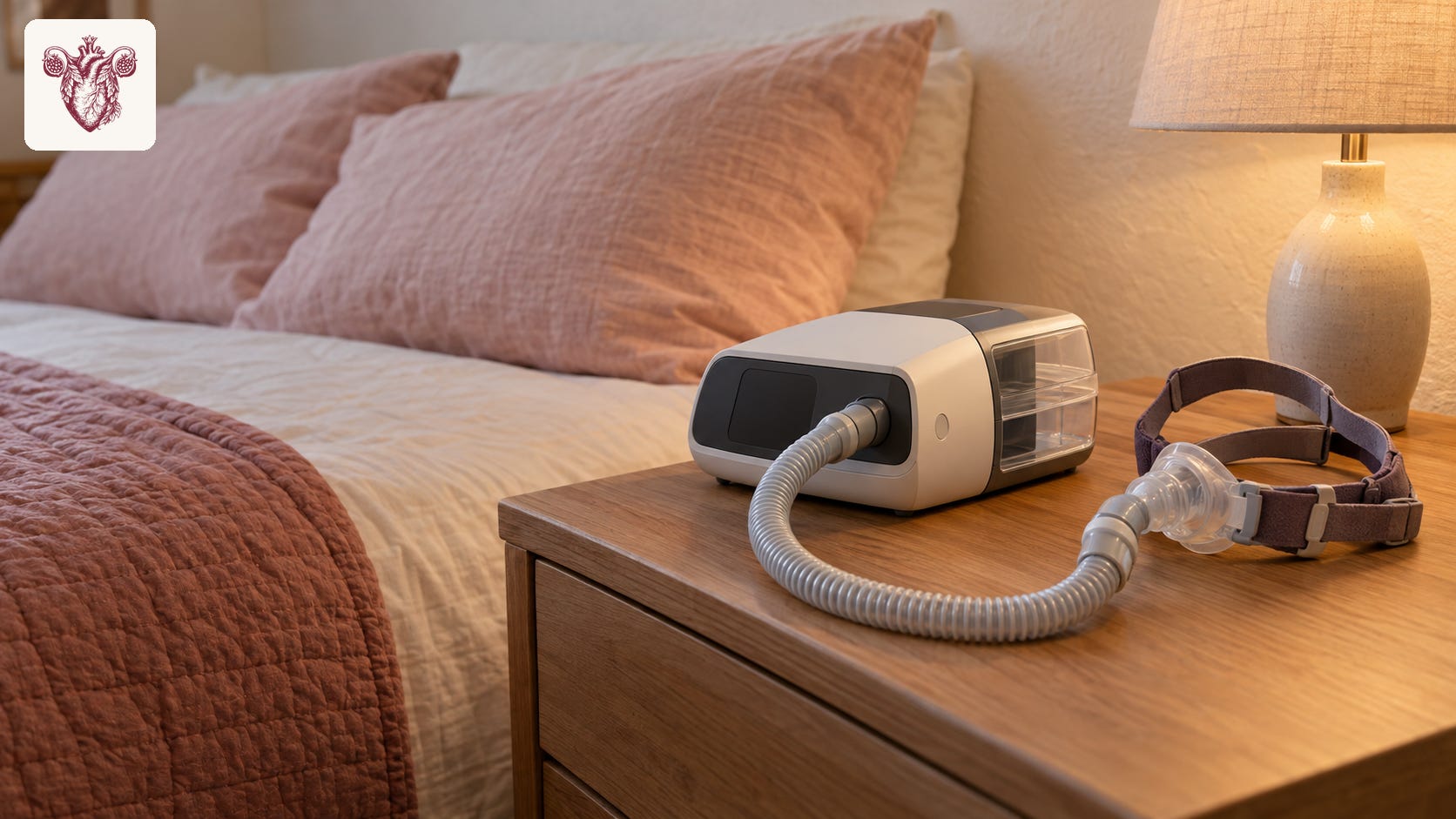
A CPAP machine delivers gentle air pressure through a mask to keep your airway open.
Across randomized trials, CPAP lowered 24-hour blood pressure by roughly 2 to 3 mm Hg on average, with somewhat larger reductions in people whose hypertension was resistant to medication.¹⁰
In the HIPARCO trial of patients with sleep apnea and resistant hypertension, 12 weeks of CPAP lowered 24-hour mean and diastolic blood pressure and helped restore the normal nighttime dip. The drop in systolic pressure in the main analysis was not statistically significant. More hours of nightly use were linked to larger reductions.⁹
The practical lesson: CPAP works best when you wear it consistently, and comfort is worth troubleshooting.
If the mask leaks, the pressure feels uncomfortable, or you wake with a dry mouth, tell your sleep team. Difficulty using treatment is a problem to solve—not a personal failure.
Oral appliances
A custom, adjustable mouthpiece made by a qualified dentist moves the lower jaw forward to help keep the airway open.
CPAP remains the first-line treatment for most people. An oral appliance is a recommended option if you cannot tolerate CPAP or prefer an alternative, with follow-up testing to confirm it is working.¹¹
In one meta-analysis, CPAP and oral appliances produced similar average blood-pressure reductions.²² That does not mean the two control breathing equally well in every person.
Weight-related treatment
When excess weight contributes to sleep apnea, weight-related treatment can reduce its severity. You should not have to wait for weight loss before discussing airway treatment.
In December 2024, the FDA approved tirzepatide (Zepbound) for moderate-to-severe obstructive sleep apnea in adults with obesity, alongside a reduced-calorie diet and increased physical activity. The agency attributed the improvement in breathing events largely to weight reduction.²³,²⁴
Medication can support treatment. It does not replace a sustainable eating pattern, adequate nutrition, or activity that preserves strength.
Some people need long-term treatment. Whether to continue it—or change CPAP—depends on reassessment, not weight loss alone.
Tirzepatide has side effects and contraindications. It requires a prescribing clinician’s assessment, and starting it does not mean you should stop your existing sleep-apnea treatment.²³
What treatment does not promise
Treating sleep apnea complements blood-pressure care. It does not guarantee that you can reduce or stop medication.
Keep measuring at home and share the log. If your readings improve, your clinician can decide whether to simplify treatment safely.⁹,¹⁰,¹⁹
Do not change medication on your own after starting CPAP, an oral appliance, or weight-related treatment.
If you want to work toward needing less medication, my book Lower Your Blood Pressure: Help Your Doctor Reduce Your Medication walks through how to do that safely, together with your clinician. It is available in paperback and on Kindle.
Hormone therapy is a separate decision
Some observational studies have linked hormone therapy with less sleep-disordered breathing. That is interesting, but it does not make hormone therapy a treatment for sleep apnea.¹²,¹³
In the Sleep Heart Health Study, women age 50 and older who used hormone therapy had lower adjusted odds of moderate-to-severe sleep-disordered breathing than nonusers.¹²
But women who choose hormone therapy may differ from nonusers in ways that also affect sleep, and not every study has found the same association. Hormone therapy has not given consistent results as a treatment for sleep apnea.¹,¹³
The principle is the same one I discussed in “Two Decisions, Not One.”²⁵ Hormone therapy is a decision about bothersome menopausal symptoms and, in appropriate patients, bone health.²⁶ It is not a treatment for sleep apnea or high blood pressure.¹³,²⁶
If you have hot flashes and disrupted sleep, evaluating your breathing and discussing hormone therapy are separate conversations. You may need both—not a choice between them.
Coming back to the quiet version
If your sleep has changed, your energy has faded, and your blood pressure has crept up, menopause may explain part of it.
It may not explain all of it.
The useful question is not, “Is this just menopause?”
It is:
“Could something be happening to my breathing while I sleep—and what would it take to find out?”
Bring these three questions to your next appointment:
“My sleep, energy, and blood pressure have all changed. Could sleep apnea be part of this, even though I don’t snore loudly?”
“My morning readings are usually my highest. Would a sleep study or 24-hour blood-pressure monitoring help?”
“If my home sleep test is negative but my symptoms continue, should I have an in-laboratory study?”
You deserve sleep that restores you and a blood-pressure plan built on the full picture.
The quiet version is easy to miss. When it is present, it gives us another contributor we can treat.
Finding it begins with a question.
This post is for general educational purposes only. It is not medical advice, is not a substitute for care from your own physician, and does not create a physician-patient relationship. Do not start, stop, or change any treatment based on what you read here. If you think you may have a medical emergency, call 911 or go to the nearest emergency department.
Also by Dr. Azhak: Lower Your Blood Pressure: Help Your Doctor Reduce Your Medication, by Sameer Azhak, MD, FACC. Available on Amazon in paperback and Kindle.
© 2026 Cordate Press
References
Young T, Finn L, Austin D, Peterson A. Menopausal status and sleep-disordered breathing in the Wisconsin Sleep Cohort Study. Am J Respir Crit Care Med. 2003;167(9):1181–1185. doi:10.1164/rccm.200209-1055OC. https://pubmed.ncbi.nlm.nih.gov/12615621/
National Heart, Lung, and Blood Institute. Sleep apnea and women. Accessed October 19, 2026. https://www.nhlbi.nih.gov/health/sleep-apnea/women
National Institutes of Health, Office of Research on Women’s Health. Obstructive sleep apnea (OSA) research overview. DiscoverWHR. Accessed October 19, 2026. https://discoverwhr.nih.gov/research/obstructive-sleep-apnea-osa/
Yeghiazarians Y, Jneid H, Tietjens JR, et al. Obstructive sleep apnea and cardiovascular disease: a scientific statement from the American Heart Association. Circulation. 2021;144(3):e56–e67. doi:10.1161/CIR.0000000000000988. https://www.ahajournals.org/doi/10.1161/CIR.0000000000000988
Kario K, Hettrick DA, Prejbisz A, Januszewicz A. Obstructive sleep apnea–induced neurogenic nocturnal hypertension: a potential role of renal denervation? Hypertension. 2021;77(4):1047–1060. doi:10.1161/HYPERTENSIONAHA.120.16378. https://www.ahajournals.org/doi/10.1161/HYPERTENSIONAHA.120.16378
Pena Orbea CA, Lloyd RM, Faubion SS, Miller VM, Mara KC, Kapoor E. Predictive ability and reliability of the STOP-BANG questionnaire in screening for obstructive sleep apnea in midlife women. Maturitas. 2020;135:1–5. doi:10.1016/j.maturitas.2020.02.004. https://pmc.ncbi.nlm.nih.gov/articles/PMC7644815/
Sung ER, Collop N. Obstructive sleep apnoea in women: what do we know and what don’t we know? Respirology. 2025;30(12):1127–1130. doi:10.1002/resp.70136. https://onlinelibrary.wiley.com/doi/10.1002/resp.70136
Kapur VK, Auckley DH, Chowdhuri S, et al. Clinical practice guideline for diagnostic testing for adult obstructive sleep apnea: an American Academy of Sleep Medicine clinical practice guideline. J Clin Sleep Med. 2017;13(3):479–504. doi:10.5664/jcsm.6506. https://aasm.org/resources/clinicalguidelines/diagnostic-testing-osa.pdf
Martínez-García MA, Capote F, Campos-Rodríguez F, et al. Effect of CPAP on blood pressure in patients with obstructive sleep apnea and resistant hypertension: the HIPARCO randomized clinical trial. JAMA. 2013;310(22):2407–2415. doi:10.1001/jama.2013.281250. https://jamanetwork.com/journals/jama/fullarticle/1788459
Hu X, Fan J, Chen S, Yin Y, Zrenner B. The role of continuous positive airway pressure in blood pressure control for patients with obstructive sleep apnea and hypertension: a meta-analysis of randomized controlled trials. J Clin Hypertens (Greenwich). 2015;17(3):215–222. doi:10.1111/jch.12472. https://onlinelibrary.wiley.com/doi/full/10.1111/jch.12472
Ramar K, Dort LC, Katz SG, et al. Clinical practice guideline for the treatment of obstructive sleep apnea and snoring with oral appliance therapy: an update for 2015. J Clin Sleep Med. 2015;11(7):773–827. doi:10.5664/jcsm.4858. https://pubmed.ncbi.nlm.nih.gov/26094920/
Shahar E, Redline S, Young T, et al. Hormone replacement therapy and sleep-disordered breathing. Am J Respir Crit Care Med. 2003;167(9):1186–1192. doi:10.1164/rccm.200210-1238OC. https://academic.oup.com/ajrccm/article/167/9/1186/8520888
Antonaglia C, Citton GM, Siciliano M, et al. Obstructive sleep apnea syndrome in women: gender in sleep respiratory medicine is a first step towards personalized medicine. Sleep Breath. 2025;29(4):250. doi:10.1007/s11325-025-03420-1. https://pmc.ncbi.nlm.nih.gov/articles/PMC12287190/
Bonsignore MR, Saaresranta T, Riha RL. Sex differences in obstructive sleep apnoea. Eur Respir Rev. 2019;28(154):190030. doi:10.1183/16000617.0030-2019. https://publications.ersnet.org/content/errev/28/154/190030
Wang Y, Liu H, Zhou B, Yue W, Wang M, Hu K. Menopause and obstructive sleep apnea: revealing an independent mediating role of visceral fat beyond body mass index. BMC Endocr Disord. 2025;25:21. doi:10.1186/s12902-025-01850-2. https://pmc.ncbi.nlm.nih.gov/articles/PMC11765922/
Mirer AG, Young T, Palta M, Benca RM, Rasmuson A, Peppard PE. Sleep-disordered breathing and the menopausal transition among participants in the Sleep in Midlife Women Study. Menopause. 2017;24(2):157–162. doi:10.1097/GME.0000000000000744. https://sleepcohort.wisc.edu/wp-content/uploads/sites/1452/2020/09/2017_Mirer_FREE_Menopause_SDB-menopausal-transition-among-participants-in-Sleep-in-Midlife-Women-Study.pdf
Qaseem A, Kansagara D, Forciea MA, Cooke M, Denberg TD; Clinical Guidelines Committee of the American College of Physicians. Management of chronic insomnia disorder in adults: a clinical practice guideline from the American College of Physicians. Ann Intern Med. 2016;165:125–133. doi:10.7326/M15-2175. ACP guideline.
Gao CC, Kapoor E, Lipford MC, et al. Association of vasomotor symptoms and sleep apnea risk in midlife women. Menopause. 2018;25(4):391–398. doi:10.1097/GME.0000000000001020. https://pmc.ncbi.nlm.nih.gov/articles/PMC5866162/
Azhak S. The menopause blood pressure rollercoaster. The Menopause Heart. October 6, 2026. https://www.themenopauseheart.com/p/the-menopause-blood-pressure-rollercoaster
Geyer C. In search of a good night’s sleep: hormones, mind, movement, and breath. Am J Lifestyle Med. 2018;12(2):120–123. Published online December 28, 2017. doi:10.1177/1559827617747222. https://pmc.ncbi.nlm.nih.gov/articles/PMC6124991/
Patil SP, Ayappa IA, Caples SM, Kimoff RJ, Patel SR, Harrod CG. Treatment of adult obstructive sleep apnea with positive airway pressure: an American Academy of Sleep Medicine clinical practice guideline. J Clin Sleep Med. 2019;15(2):335–343. doi:10.5664/jcsm.7640. Full guideline.
Bratton DJ, Gaisl T, Wons AM, Kohler M. CPAP vs mandibular advancement devices and blood pressure in patients with obstructive sleep apnea: a systematic review and meta-analysis. JAMA. 2015;314(21):2280–2293. doi:10.1001/jama.2015.16303. https://pubmed.ncbi.nlm.nih.gov/26624827/
U.S. Food and Drug Administration. FDA approves first medication for obstructive sleep apnea. December 20, 2024. https://www.fda.gov/news-events/press-announcements/fda-approves-first-medication-obstructive-sleep-apnea
Malhotra A, Grunstein RR, Fietze I, et al. Tirzepatide for the treatment of obstructive sleep apnea and obesity. N Engl J Med. 2024;391(13):1193–1205. doi:10.1056/NEJMoa2404881. https://pubmed.ncbi.nlm.nih.gov/38912654/
Azhak S. Two decisions, not one: the menopause visit your heart deserves. The Menopause Heart. September 1, 2026. https://www.themenopauseheart.com/p/two-decisions-not-one-the-menopause
The North American Menopause Society. The 2022 hormone therapy position statement of The North American Menopause Society. Menopause. 2022;29(7):767–794. doi:10.1097/GME.0000000000002028. Position statement.
This is such a useful corrective. Broken sleep after menopause is blamed on hot flushes or “stress” so routinely that a breathing evaluation rarely makes the list, and, as you say, in women it often presents as insomnia, fatigue and low mood rather than snoring. The point that STOP-BANG was validated mostly in men deserves repeating to every clinician who uses it. I’d add that repeated night-time arousals keep the sympathetic system switched on, which is one more reason blood pressure and sleep belong in the same conversation. A clear, careful piece.
This is very informative. I recently had myself checked and it was pretty easy!