

She came in to establish care with a new cardiologist and to have her heart risk checked. She was in her late 40s, in perimenopause, and she had already done something many people struggle to do: she had her cholesterol under control.
On a statin, her LDL was 70 mg/dL. Her HDL was 61, and her triglycerides were 79. Her coronary calcium score, done a few years earlier, was zero.
But the rest of her chart told a different story. She had lived with high blood pressure since her 20s. A recent ultrasound showed plaque in the carotid arteries on both sides of her neck. Her fasting glucose was 104 mg/dL, and her A1c was 6.3%. She had a strong family history of stroke and heart attack. Because she was getting short of breath on stairs, I also ordered an echocardiogram and a stress test.
She was also frustrated. She found it hard to cut back on sweets. She had tried fasting for up to 12 hours and eating smaller meals, and the scale hadn’t moved.
Her cholesterol was handled. Her blood sugar showed prediabetes, while her blood pressure and her arteries pointed to cardiovascular risk that still needed attention. Insulin resistance was one likely contributor to address. And the place to start was her plate.
This article is about how to look at your own plate the way we looked at hers, and how to correct course one meal at a time.
Identifying details have been changed to protect patient privacy.
The quiet numbers
Her fasting glucose of 104 and A1c of 6.3% both fall in the prediabetes range: a fasting glucose of 100 to 125 mg/dL or an A1c of 5.7% to 6.4%.¹
“Pre” can sound like a waiting room, but the heart doesn’t experience it that way. Prediabetes is linked to higher risk of cardiovascular disease, coronary heart disease and stroke.²
Her lipid panel hid this. Insulin resistance often shows up as high triglycerides and low HDL, but hers were excellent, especially on a statin.³ In her case, her blood sugar revealed a problem that her lipid panel did not capture. Lowering LDL can slow plaque progression and sometimes reduce plaque, but a good LDL does not mean that all existing plaque or cardiovascular risk has disappeared.⁴
The doorbell and the response
When I sat down with her to explain insulin resistance, I described it this way.
Insulin’s job is to ring the doorbell on your cells. When it rings, the cell opens the door and lets glucose in to be used for energy.⁵
Now imagine the doorbell rings, but the response inside the house has become weaker. That is the useful part of the analogy for insulin resistance. The body may compensate by producing more insulin, but the cells respond less well. If that compensation is no longer enough, more glucose stays in the blood. The analogy does not mean that normal insulin release after meals is harmful or that frequent eating alone causes insulin resistance.⁵
High insulin can help promote new fat production in the liver, a process called de novo lipogenesis.⁶ In insulin resistance, the liver may keep releasing glucose while also making excess fat through several overlapping pathways.⁷ The liver exports triglyceride-rich particles called VLDL; later changes in the bloodstream can produce smaller, denser LDL particles.³
The kind of meal matters. A meal high in refined carbohydrates and low in fiber can raise blood sugar quickly.⁸ In research from Yale, insulin-resistant young, lean adults stored less carbohydrate in their muscles after high-carbohydrate mixed meals, and their livers made more than twice as much new fat as those of insulin-sensitive peers.⁹ As I explained to her, the liver rushes to process everything arriving at once.
Fiber and balanced meals can slow the rise in blood sugar, while movement helps muscles use glucose.⁸, ¹⁰ The goal is a better response to insulin, not avoiding the normal insulin response to food.
Why it’s worth the effort
Treating insulin resistance before diabetes develops may protect the heart, not just blood sugar.
In the Da Qing study in China, adults with impaired glucose tolerance, one form of prediabetes, who followed diet and exercise programs for six years had 26% fewer cardiovascular events and 33% fewer cardiovascular deaths over 30 years of follow-up, including the six-year intervention.¹¹
A December 2025 re-analysis of US and Chinese prevention trials found that people whose blood sugar returned to the normal range had about half the risk of cardiovascular death or heart failure hospitalization over approximately 20 years in the US cohort and 30 years in the Chinese cohort. The authors wrote that “targeting remission might represent a new approach to cardiovascular prevention”.¹² That finding is an association, not proof of cause. But it points to a hopeful idea: how far your blood sugar comes down may matter.
Perimenopause adds urgency. In one longitudinal study, a fasting estimate of insulin resistance rose fastest from about a year and a half before the final period to two and a half years after, as we described in “The Four-Year Window”.¹³
What a fasting window does not tell us
Her experience is a reason to look beyond meal timing alone. In the TREAT randomized trial, adults with overweight or obesity who ate within an eight-hour window did not lose significantly more weight than those eating three structured meals a day.¹⁴
That trial tested a 16-hour fast, not the 12-hour fast she had tried, and it cannot tell us why her weight stayed the same.¹⁴
Fasting changes when you eat. It doesn’t change what’s on the plate. If a shorter eating window is filled with refined, low-fiber food, the doorbell still rings hard every time you eat.
That is why the next step isn’t a stricter clock. It is a closer look at the plate.
The self-audit: six steps
You don’t need a perfect diet, a dietitian on call or an app. You need an honest look at what you eat and a way to fix it one meal at a time.
These are practical coaching prompts, not a validated test of insulin resistance. The food examples, percentages and two-week schedule are starting points, not medical thresholds.
Step 1: Keep an honest food log for three days
Write down everything you eat and drink for three days, including one weekend day. Note:
What and how much: “two slices of white toast with jam” is more useful than “toast.”
When: the time of each meal and snack.
Cravings: when they hit, and what you reached for.
Don’t change anything yet. The goal is to see your real pattern, not your best behavior.
Step 2: Ask the doorbell questions about every meal
Go through your log, meal by meal, and ask five questions:
Where’s the fiber? Vegetables, beans, lentils, whole fruit, nuts, seeds and intact whole grains.¹⁵ People who ate the most fiber had 15% to 30% lower rates of cardiovascular death, coronary disease, stroke and type 2 diabetes than those who ate the least. The benefits were greatest at about 25 to 29 grams a day or more.¹⁶
Is the carbohydrate refined or whole? White bread and many pastries and crackers use refined grains. For packaged cereals, check the ingredient list for whole grains and the label for added sugar.¹⁵ Steel-cut oats, beans and whole fruit are not refined grains; they contain intact fiber.
Is there protein or healthy fat to slow it down? Eggs, fish, Greek yogurt, beans, tofu, nuts, olive oil.⁸
How much added sugar? Check labels. The American Heart Association recommends women keep added sugar to no more than 25 grams, about 6 teaspoons, a day.¹⁷
Was any of it a drink? Sweet coffee drinks, juice and soda can deliver a large amount of sugar without the fiber of whole fruit.¹⁵ In the Nurses’ Health Study II, which followed more than 90,000 women for eight years, those who drank one or more sugar-sweetened soft drinks a day had an 83% higher risk of type 2 diabetes than those who drank less than one a month.¹⁸
A meal with several of these features is a useful place to look for a change.
Step 3: Find your patterns
Look for one to three problem spots that repeat. Common ones include:
A refined breakfast: white toast with a sweet spread, a pastry, a bowl of sweetened cereal or a flavored coffee drink. Almost no fiber, almost no protein.
The afternoon slump: a cookie, candy or something from the office break room around 3 p.m.
Evening grazing: snacking after dinner, often on sweets, when tired or stressed.
“Healthy” foods with hidden sugar: flavored yogurt, granola, smoothies and bars.
These are the meals worth fixing first.
Step 4: Fix one meal at a time
Start with one meal or snack you want to improve, and focus on that for two weeks. Then move to the next.
Some examples:
Breakfast: Swap white toast for sprouted whole-grain bread or crackers made mostly from seeds. Another option is steel-cut oats.
Afternoon snack: Swap a cookie for a date with three almonds and a square of 70% dark chocolate.
Lunch: Swap a white-bread sandwich and chips for a big salad with beans or chicken, olive oil and a slice of whole-grain bread.
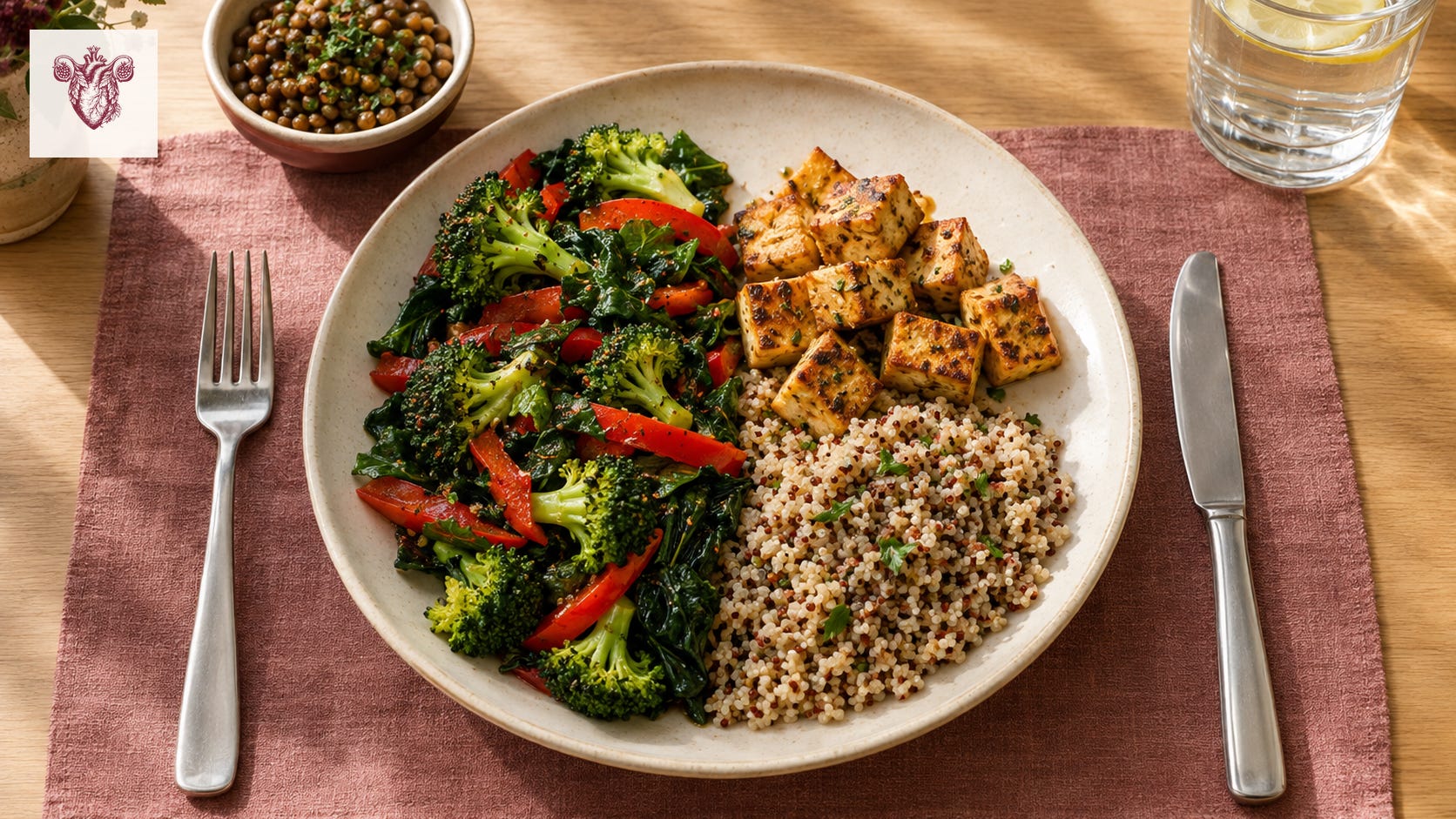
Dinner: Fill half the plate with vegetables, a quarter with protein and a quarter with a whole grain or beans.⁸
Sweet cravings: When you crave something sweet, reach for a piece of fruit 80% to 90% of the time.
Dessert: If you want something sweet, have it right after a meal rather than on its own, and keep the portion small.
Order can help too. In a small pilot study of 11 adults with type 2 diabetes, eating vegetables and protein before the carbohydrate in the same meal produced markedly lower blood sugar and insulin afterward than eating the carbohydrate first.¹⁹
For her, I also emphasized folate-rich green leafy vegetables, such as spinach, kale, romaine and other greens. They fit the larger plan anyway. Folate also helps the body clear homocysteine, one of the markers we checked.²⁰ Lowering homocysteine with B vitamins has not been shown to prevent heart attacks, so it is a number we watch, not the goal.²¹
Step 5: Move after you eat
Your muscles help take up and store glucose after a meal, and moving them helps them answer the door. A meta-analysis of small randomized trials, in people with and without type 2 diabetes, found that exercise after a meal lowered the rise in blood sugar that follows it.¹⁰ Regular exercise also improves how muscle responds to insulin over time.²²
If you have unexplained shortness of breath, chest discomfort or symptoms being evaluated for heart disease, ask your clinician what level of activity is appropriate before increasing it.²³
A 10- to 15-minute walk after your largest meal is a good place to start.²⁴ She had recently started cycling, and our plan added more walking.
Step 6: Re-measure
The point of a self-audit is to see whether your changes work.
At home: your waist, measured at the same spot each time, just above the hip bones,²⁵ every few weeks; your home blood pressure; and how often cravings hit compared with when you started.
With your doctor: repeat labs after a few months.
Her plan: food first, then let the labs speak
We did not change her medicines. Instead, we took a serious look at her diet as the starting point for making better choices: fewer refined, high-glycemic foods, more fiber, more leafy greens and more walking.
Before she started, I checked a deeper set of baseline markers, including her fasting insulin, lipoprotein(a), hs-CRP, homocysteine, ApoB and an advanced particle test. Her echocardiogram and stress test were also pending.
This was her individualized assessment, not a routine test panel every reader needs. Routine fasting-insulin testing is not recommended for most people at risk for diabetes, and changes in these markers do not by themselves prove that plaque has improved.²⁶
When she returns, these are the numbers we will be watching:
HOMA-IR, calculated from fasting insulin and glucose: is this estimate of insulin resistance changing?¹³
ApoB and LDL particle number: are there fewer cholesterol-carrying particles? Larger particle size would be a secondary sign, not the goal.
hs-CRP: is inflammation coming down?
Homocysteine: if it was elevated, has it come down?
A1c and fasting glucose: are they moving back toward normal?
I don’t know yet what her numbers will show, and neither does she. That is the point of measuring.
A word about medications
Some medicines can nudge blood sugar upward. Statins can cause a small rise in blood sugar. In trials, most new diabetes diagnoses occurred in people already close to the diagnostic threshold, while the cardiovascular benefits remained important for people who needed statin treatment.²⁷ Some older beta blockers are linked to more new cases of diabetes, while ACE inhibitors and ARBs have been associated with a lower risk.²⁸, ²⁹ The right choice also depends on why the medicine was prescribed. She took both a statin and an older beta blocker.
None of this is a reason to stop a medicine on your own. If you have prediabetes, it is worth asking your doctor whether your current medicines are the best fit for your metabolism.
The takeaway
Getting your LDL under control is a real win. It is where prevention begins, not where it ends.
For her, the unfinished business was prediabetes and concern about insulin resistance, and an important tool was one she already had: the ability to look honestly at her own plate. Log what you eat. Ask the doorbell questions. Find your patterns. Fix one meal at a time. Move after you eat. Then measure again.
You don’t need a perfect diet. You need to see what your plate is doing, and to keep correcting it.
Next week, we go deeper into what a history of PMOS (formerly PCOS) means for your heart at midlife.
This post is for general educational purposes only. It is not medical advice, is not a substitute for care from your own physician, and does not create a physician-patient relationship. Do not start, stop, or change any treatment based on what you read here. If you think you may have a medical emergency, call 911 or go to the nearest emergency department.
Also from Cordate Press: The Integrative Cardiologist, our flagship publication for broad prevention
Also by Dr. Azhak: Lower Your Blood Pressure: Help Your Doctor Reduce Your Medication, by Sameer Azhak, MD, FACC. Available on Amazon in paperback and Kindle.
© 2026 Cordate Press
References
American Diabetes Association Professional Practice Committee for Diabetes. 2. Diagnosis and classification of diabetes: Standards of Care in Diabetes—2026. Diabetes Care. 2026;49(Suppl 1):S27–S49. doi:10.2337/dc26-S002. PubMed Central
Cai X, Zhang Y, Li M, et al. Association between prediabetes and risk of all cause mortality and cardiovascular disease: updated meta-analysis. BMJ. 2020;370:m2297. doi:10.1136/bmj.m2297. PubMed Central
Feingold KR. Dyslipidemia in Patients with Diabetes. In: Endotext. MDText.com. Updated July 12, 2026. Endotext
Nissen SE, Nicholls SJ, Sipahi I, et al. Effect of very high-intensity statin therapy on regression of coronary atherosclerosis: the ASTEROID trial. JAMA. 2006;295(13):1556–1565. doi:10.1001/jama.295.13.jpc60002. PubMed
National Institute of Diabetes and Digestive and Kidney Diseases. Insulin Resistance & Prediabetes. Reviewed March 2025. NIDDK
DeFronzo RA. Insulin resistance, lipotoxicity, type 2 diabetes and atherosclerosis: the missing links. The Claude Bernard Lecture 2009. Diabetologia. 2010;53(7):1270–1287. doi:10.1007/s00125-010-1684-1. PubMed Central
Petersen MC, Shulman GI. Mechanisms of insulin action and insulin resistance. Physiol Rev. 2018;98(4):2133–2223. doi:10.1152/physrev.00063.2017. PubMed Central
Centers for Disease Control and Prevention. Diabetes Meal Planning. Accessed November 8, 2026. CDC
Petersen KF, Dufour S, Savage DB, et al. The role of skeletal muscle insulin resistance in the pathogenesis of the metabolic syndrome. Proc Natl Acad Sci U S A. 2007;104(31):12587–12594. doi:10.1073/pnas.0705408104. PNAS
Engeroff T, Groneberg DA, Wilke J. After Dinner Rest a While, After Supper Walk a Mile? A systematic review with meta-analysis on the acute postprandial glycemic response to exercise before and after meal ingestion in healthy subjects and patients with impaired glucose tolerance. Sports Med. 2023;53(4):849–869. doi:10.1007/s40279-022-01808-7. PubMed Central
Gong Q, Zhang P, Wang J, et al. Morbidity and mortality after lifestyle intervention for people with impaired glucose tolerance: 30-year results of the Da Qing Diabetes Prevention Outcome Study. Lancet Diabetes Endocrinol. 2019;7(6):452–461. doi:10.1016/S2213-8587(19)30093-2. PubMed
Vazquez Arreola E, Gong Q, Hanson RL, et al. Prediabetes remission and cardiovascular morbidity and mortality: post-hoc analyses from the Diabetes Prevention Program Outcome study and the DaQing Diabetes Prevention Outcome study. Lancet Diabetes Endocrinol. 2026;14(2):137–148. Published online December 12, 2025. doi:10.1016/S2213-8587(25)00295-5. PubMed
Karlamangla AS, Han WJ, Srikanthan P, et al. Development of insulin resistance in women over the menopause transition. JCI Insight. In-Press Preview, October 6, 2026. doi:10.1172/jci.insight.206342. JCI Insight
Lowe DA, Wu N, Rohdin-Bibby L, et al. Effects of time-restricted eating on weight loss and other metabolic parameters in women and men with overweight and obesity: the TREAT randomized clinical trial. JAMA Intern Med. 2020;180(11):1491–1499. doi:10.1001/jamainternmed.2020.4153. PubMed Central
Centers for Disease Control and Prevention. Healthy Swaps. Accessed November 8, 2026. CDC
Reynolds A, Mann J, Cummings J, et al. Carbohydrate quality and human health: a series of systematic reviews and meta-analyses. Lancet. 2019;393(10170):434–445. doi:10.1016/S0140-6736(18)31809-9. PubMed
American Heart Association. How Much Sugar Is Too Much? Reviewed May 14, 2026. American Heart Association
Schulze MB, Manson JE, Ludwig DS, et al. Sugar-sweetened beverages, weight gain, and incidence of type 2 diabetes in young and middle-aged women. JAMA. 2004;292(8):927–934. doi:10.1001/jama.292.8.927. PubMed
Shukla AP, Iliescu RG, Thomas CE, Aronne LJ. Food order has a significant impact on postprandial glucose and insulin levels. Diabetes Care. 2015;38(7):e98–e99. doi:10.2337/dc15-0429. PubMed Central
National Institutes of Health, Office of Dietary Supplements. Folate: Fact Sheet for Health Professionals. Accessed November 8, 2026. NIH Office of Dietary Supplements
Clarke R, Halsey J, Lewington S, et al. Effects of lowering homocysteine levels with B vitamins on cardiovascular disease, cancer, and cause-specific mortality: meta-analysis of 8 randomized trials involving 37 485 individuals. Arch Intern Med. 2010;170(18):1622–1631. doi:10.1001/archinternmed.2010.348. PubMed
Rebello CJ, Zhang D, Kirwan JP, et al. Effect of exercise training on insulin-stimulated glucose disposal: a systematic review and meta-analysis of randomized controlled trials. Int J Obes (Lond). 2023;47(5):348–357. doi:10.1038/s41366-023-01283-8. PubMed Central
Scott SN, Hayes C, Zeuger T, et al. Clinical considerations and practical advice for people living with type 2 diabetes who undertake regular exercise or aim to exercise competitively. Diabetes Spectr. 2023;36(2):114–126. doi:10.2337/dsi22-0015. PubMed Central
Reynolds AN, Mann JI, Williams S, Venn BJ. Advice to walk after meals is more effective for lowering postprandial glycaemia in type 2 diabetes mellitus than advice that does not specify timing: a randomised crossover study. Diabetologia. 2016;59(12):2572–2578. doi:10.1007/s00125-016-4085-2. PubMed
National Heart, Lung, and Blood Institute. Aim for a Healthy Weight. Accessed November 8, 2026. NHLBI
Sacks DB, Arnold M, Bakris GL, et al. Guidelines and recommendations for laboratory analysis in the diagnosis and management of diabetes mellitus. Diabetes Care. 2023;46(10):e151–e199. doi:10.2337/dci23-0036. PubMed Central
Cholesterol Treatment Trialists’ Collaboration. Effects of statin therapy on diagnoses of new-onset diabetes and worsening glycaemia in large-scale randomised blinded statin trials: an individual participant data meta-analysis. Lancet Diabetes Endocrinol. 2024;12(5):306–319. doi:10.1016/S2213-8587(24)00040-8. PubMed
Nazarzadeh M, Bidel Z, Canoy D, et al. Blood pressure lowering and risk of new-onset type 2 diabetes: an individual participant data meta-analysis. Lancet. 2021;398(10313):1803–1810. doi:10.1016/S0140-6736(21)01920-6. PubMed
Elliott WJ, Meyer PM. Incident diabetes in clinical trials of antihypertensive drugs: a network meta-analysis. Lancet. 2007;369:201–207. doi:10.1016/S0140-6736(07)60108-1. ScienceDirect